
Percent, BOGO or Free Delivery: How Platforms Discount
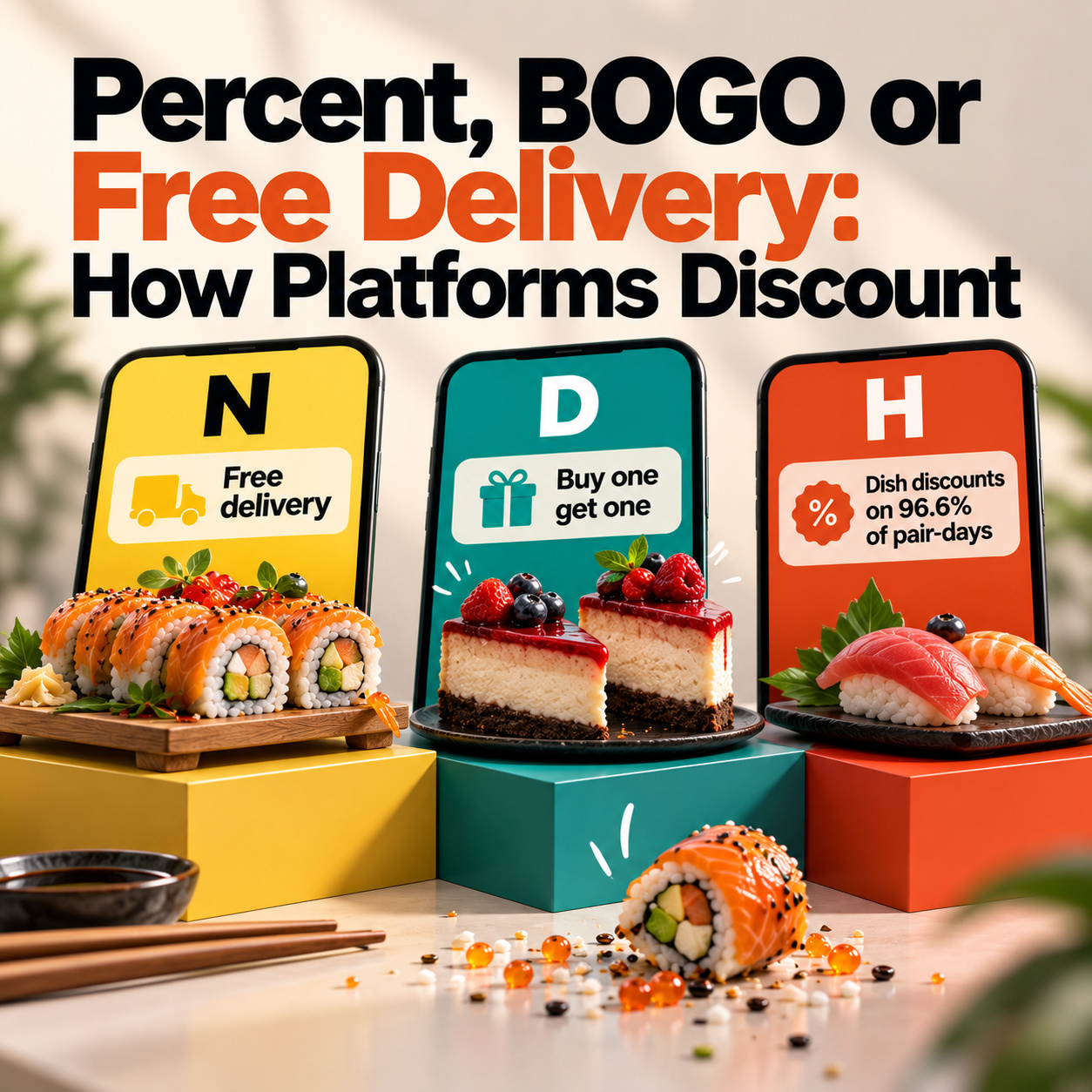
In August 2026, platforms showed a store-level promo on 91.5–100% of UAE listings, so having a promo no longer sets a listing apart. What differs, platform by platform, is the shape of the promo. On Noon, 100% of promo-days included free delivery; on Deliveroo UAE, 40.9% were buy-one-get-one; on HungerStation, 96.6% of all pair-days carried dish-level discounts, and store-level percentage promos had a median of 20%. Each platform’s listings show their own mix of mechanics.
Everyone discounts. Not everyone discounts the same way.
Listings on the same app tend to show the same kind of promo, and different apps show different kinds. Open your brand’s listing on Talabat, Noon and Deliveroo in the UAE on the same day and you can find three different kinds of offer: a percentage off on one, free delivery plus a percentage on another, buy-one-get-one on the third.
Presence is no longer the question. Among restaurants monitored by Kitchain, platforms showed a store-level promo on Noon 100%, Keeta 98.9%, Talabat 97.3%, Careem 92.7% and Deliveroo 91.5% of UAE listings in August, and on 99.9% of HungerStation listings in Saudi Arabia. The one platform in our sample with no store-level promo at all was Jahez in Kuwait: 0%, on every Jahez listing we covered. We covered presence and depth in our Promo Barometer; this article is about form.
Throughout, we say “the platform shows a promo in this form”, not “restaurants choose this mechanic”. Each UAE platform showed only 8 to 24 distinct store-level promos over the whole of August, and on most of them two or three discount sizes covered 96–98% of percentage promo-days. The result is highly uniform across listings on a platform. The data shows that uniformity, not who set each promo.
Here is the mechanic mix by platform and market. Each figure is a share of promo-days, except the last column, which is a separate count on a different base.
| Market | Platform | Percentage off | Flat amount off | Free delivery | Buy-one-get-one | Item-level discounts (share of all pair-days) |
|---|---|---|---|---|---|---|
| UAE | Careem | 100% | 0% | 0% | 0% | 1.4% |
| UAE | Keeta | 100% | 0% | 0% | 0% | 0% |
| UAE | Talabat | 100% | 0% | 0% | 0% | 40.3% |
| UAE | Noon | 99.9% | 16.1% | 100% | 0% | 0% |
| UAE | Deliveroo | 59.1% | 0% | 0% | 40.9% | 0% |
| Saudi Arabia | HungerStation | 100% | 0% | 0% | 0% | 96.6% |
| Saudi Arabia | Keeta | 100% | 0% | 0% | 0% | 0% |
| Kuwait | Deliveroo | 100% | 0% | 0% | 0% | 0% |
| Kuwait | Keeta | 100% | 0% | 0% | 0% | 0% |
| Kuwait | Talabat | 100% | 0% | 0% | 0% | 19.7% |
| UK | Just Eat | 92.4% | 0% | 0% | 0% | 37.8% |
| UK | Uber Eats | 0% | 0% | 0% | 99.9% | 0% |
One promo-day can carry several mechanics at once, so a row can add up to more than 100%. Noon’s does.
What this means for a restaurant: the mechanic mix differs by platform and by market. Before you ask “should we run a promo on this platform?”, ask “what form do promos take on listings there?”
The default: a percentage off, in two or three sizes
On most Gulf platforms, the promo listings show is a percentage off, in one of a few standard sizes.
In August, 100% of promo-days were a percentage off on Careem, Keeta and Talabat in the UAE, on HungerStation and Keeta in Saudi Arabia, and on Deliveroo, Keeta and Talabat in Kuwait. No flat amounts, no free delivery, no buy-one-get-one at store level.
The sizes are just as narrow. As a share of each platform’s percentage promo-days in the UAE:
- Careem: 50% off on 63% and 30% off on 34%. Two sizes, 97% of promo-days.
- Talabat: 50% off on 64% and 30% off on 32%. Two sizes, 96%.
- Keeta: 50% off on 50%, 40% off on 27% and 30% off on 21%. Three sizes, 98%.
Talabat UAE comes with one clause: its store-level promos are all percentage, but its listings also show dish-level discounts on 40.3% of pair-days. We come back to that layer below.
What this means for a restaurant: on these platforms the customer almost always sees one number: 50% or 30%, sometimes 40%. That is the frame your listing sits in next to everyone else’s. If you plan a promo calendar for Careem, Keeta or Talabat in the UAE, plan it with those sizes in view.
On Noon, the promo is free delivery plus a percentage
On Noon, every promo-day included free delivery, and the percentage part is shallower than on any other UAE platform.
In August, 100% of Noon’s promo-days included free delivery. 99.9% also carried a percentage off, and 16.1% added a flat amount off, with a median of AED 35. None of the other four UAE platforms showed free delivery on any promo-day.
The percentage part is also the most spread out in the UAE. As a share of Noon’s percentage promo-days:
- 30% off: 45%
- 20% off: 21%
- 50% off: 14%
- 35% off: 10%
- 25% off: 8%
That gives Noon a median of 35%, with the middle half of percentage promo-days between 30% and 50%. Noon is the only UAE platform with a median below 50%; Careem, Keeta, Talabat and Deliveroo UAE all sit at 50%.
For a brand, the takeaway: on Noon, read “promo”, not “discount”. The customer sees free delivery plus a percentage, and the percentage is usually smaller than on the next app. If your brand competes on the delivery fee rather than on the headline cut, Noon’s listings already show that shape. If it competes on “half off”, the promos around your Noon listing carry a different message.
Buy one, get one: Deliveroo UAE and Uber Eats UK
The share of buy-one-get-one differs by platform and by market, and it can change from one month to the next.
On Deliveroo UAE, 40.9% of promo-days were buy-one-get-one in August. The other 59.1% were a percentage off, and within that part, 50% off covered 68% of its percentage promo-days, 30% off 15% and 20% off 9%. In July, buy-one-get-one was 15.5% of Deliveroo UAE promo-days. That rise is indicative: our UAE sample grew over the summer, so it is the platform’s share across a changed sample, not the same restaurants switching mechanic.
Cross the border and the picture changes. On Deliveroo in Kuwait, 100% of promo-days were a percentage off and none were buy-one-get-one. Same platform, different market, different mix.
The clearest buy-one-get-one platform in our sample is outside the Gulf. On Uber Eats UK, 99.9% of promo-days were buy-one-get-one and none were a percentage off. That also means Uber Eats UK has no discount depth to report: its depth is not defined, not zero.
In practice: if your menu is built around combos and meal deals, look for the platforms and markets where listings show buy-one-get-one. Elsewhere, the listings around yours show a percentage off. And because a platform’s mix can change from month to month, last quarter’s picture of a storefront is not a safe basis for next month’s plan.
The discount on the dish: HungerStation and Talabat
HungerStation stands out on two separate measures: dish-level discounts and a shallow store-level percentage.
Item-level discounts are a separate count from store-level promos. They are a share of all pair-days, not of promo-days, and they are not part of the presence figures above. On that base, in August:
- HungerStation: 96.6% of pair-days carried item-level discounts.
- Talabat UAE: 40.3%.
- Just Eat UK: 37.8%, as an outside contrast.
- Talabat Kuwait: 19.7%.
- Careem UAE: 1.4%.
- Keeta, Noon and Deliveroo: 0% in every market we cite.
Separately, HungerStation’s store-level percentage is uniform. Its median is 20%, and the middle half of its percentage promo-days sit at exactly 20%. Keeta in the same market has a median of 40%, and its listings show no dish-level discounts.
What this means for a restaurant: on HungerStation, dish-level discounts appear on 96.6% of all pair-days; separately, the store-level percentage is usually 20%. A brand with one hero dish should plan with both measures in view, not only the store-wide cut. On Talabat UAE, dish-level discounts appear on 40.3% of pair-days. On Keeta, Noon and Deliveroo, listings show no dish-level discounts, so the store-level promo is the only one on the screen.
Picking a platform for your promo plan
Match your menu’s natural offer to the shape each platform’s listings already show in that market. The three scenarios below are pictures, not clients.
1. A combo-led brand. Picture a burger chain in Dubai whose menu is built around meal-for-two deals, deciding where to push its next campaign. On Deliveroo UAE, 40.9% of promo-days in August were buy-one-get-one. On Careem, Keeta and Talabat UAE none were: 100% were a percentage off, mostly 50% or 30%. Its combo offer matches what listings show on one platform; on the others, the listings around it show a percentage off. Open the same chain’s Deliveroo listing in Kuwait and the picture changes again: there, 100% of promo-days were a percentage. The mechanic mix differs by platform and by market.
2. A small-basket brand. Picture a cloud kitchen in Dubai running a coffee-and-dessert virtual brand with small baskets, where the delivery fee is what makes customers hesitate. On Noon, 100% of promo-days include free delivery, and the percentage part is shallower than elsewhere: a 35% median against 50% on the other UAE platforms. On Keeta, Talabat, Careem and Deliveroo UAE, no promo-days carried free delivery. For this brand, the shape Noon’s listings show is the one it needs.
3. A hero-dish brand entering a new market. Picture a grill chain with one famous dish opening three branches in Riyadh, with a plan built around a store-wide 50% off copied from the UAE. On HungerStation the store-level percentage sits at 20% across the middle half of percentage promo-days, and dish-level discounts appear on 96.6% of all pair-days. Dish-level discounts are common there, and the store-wide percentage is usually 20%, not 50%. The plan has to be rebuilt for that market, with the hero dish in view, not translated.
In all three cases the data describes what each platform’s listings show, not what a brand can switch on. It tells you where your natural offer already fits, not that you can pick any mechanic on any app.
A mechanic is only a strategy if it actually appears on every branch × platform listing. A meal deal that shows on some Deliveroo branches and is missing on others, or a dish discount that dropped off one HungerStation listing, is invisible from the kitchen and the POS. The only way to know is to open each storefront the way a customer does.
That is what Kitchain Promo does. It opens the same public storefront pages a customer opens and takes a daily snapshot of live, missing and removed promotions across every branch and platform. You see which listings carry the offer you planned and which do not. No integration, no platform login.
How we measured
This article uses the client slice only: restaurants monitored by Kitchain, with store-level promos recorded per restaurant, per platform, per day.
- What the shares mean. A mechanic’s share is its share of pair-days that carried a store-level promo. One promo-day can carry several mechanics at once, so a platform’s shares can add up to more than 100%, as Noon’s do. Never add them up.
- What they are not. They describe the form in which a listing shows a promo, not which mechanic a restaurant chose. With few distinct promos per platform and two or three sizes covering most percentage promo-days, what listings show is highly uniform within a platform. The data does not show who set a given promo.
- Item-level discounts. A separate count, as a share of all pair-days, not included in the share of listings with a store-level promo. We do not combine them with store-level depth.
- Sizes and medians. These cover percentage promos only. Buy-one-get-one and free-delivery promos have no percentage depth, which is why Uber Eats UK’s depth is not defined.
- Period. August 2026. July 2026 is used only for the Deliveroo UAE buy-one-get-one comparison, and our UAE sample grew over the summer, so that comparison is indicative.
- Sample. We cite a platform and market only when the sample behind it clears a minimum size, which is why some platforms and cities do not appear. Demo accounts with real listings are included. Russia is excluded. Rows with an invalid percentage were dropped.
- Methodology. Version 1 of our monthly promo methodology.
Glossary:
- Pair-day. One restaurant on one platform on one day.
- Promo-day. A pair-day on which the listing carried a store-level promo.
- Store-level promo. A promotion attached to the whole listing, such as a percentage off the menu, a flat amount off, free delivery or buy-one-get-one.
- Item-level discount. A discount on an individual dish rather than on the whole listing.
- Buy-one-get-one (BOGO). A second item free with the first.
- Flat amount off. A fixed sum off the order rather than a percentage.
- Median. The middle value: half of percentage promo-days sit at or above it, half at or below.