
The Vanishing Menu: Dishes That Disappear Mid-Month
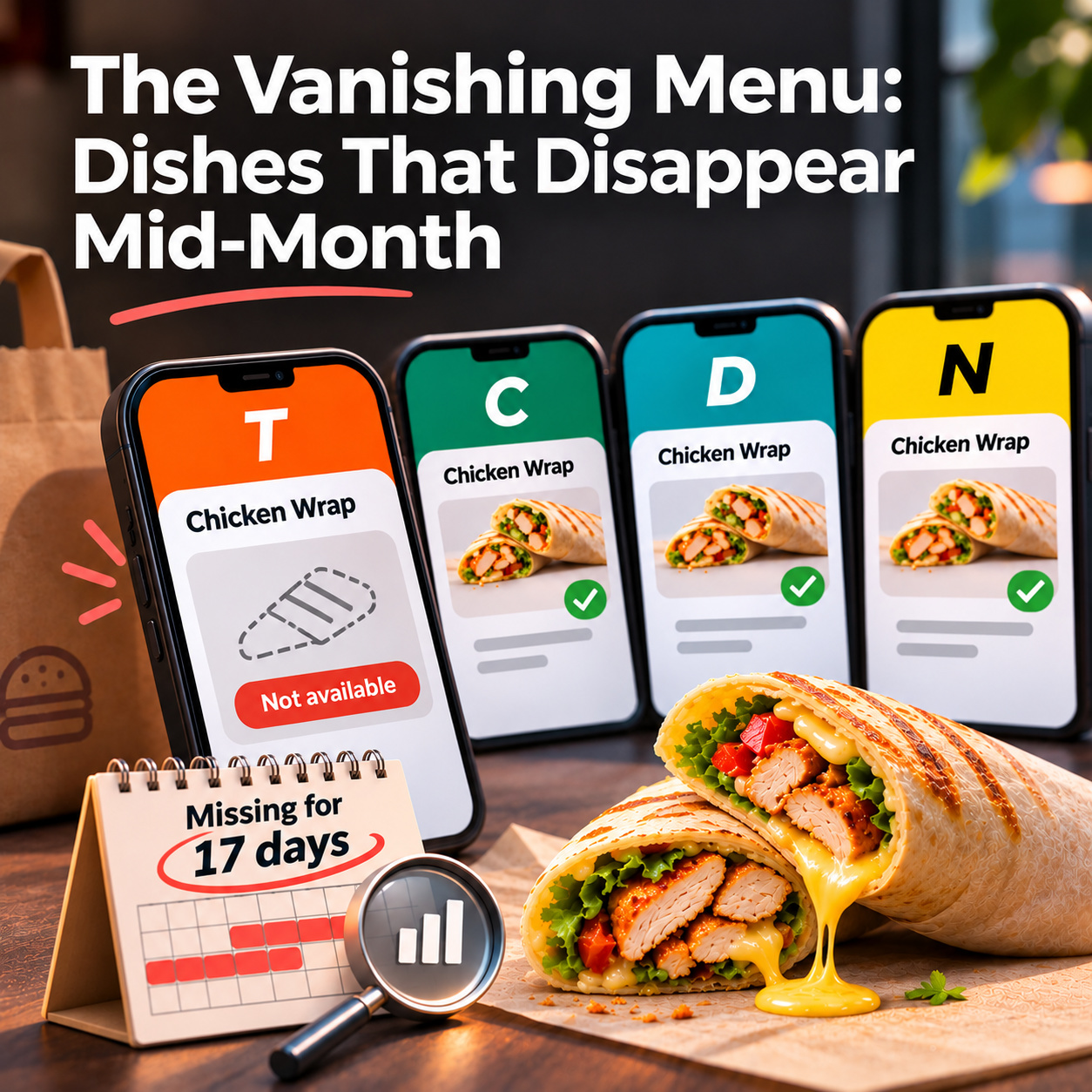
In August 2026, four in five dishes that vanished from UAE delivery menus were still on sale on another platform of the same brand at the end of the month. The dish had not left the brand’s menu; it was missing from one storefront. And the gap was not a blip: by the time the month closed, a vanished dish had been missing for a median 17 days.
The dish is still on sale. Just not on this app.
Picture this scenario: you open your brand on four delivery apps. The chicken wrap is on three of them. On the fourth it has been missing for weeks, and nobody on the team changed the menu.
In our data, a dish that is gone from one app but still on sale on another was the most common shape of a disappearance. Among restaurants monitored by Kitchain in the UAE, 2.9% of the items on delivery menus on 1 August had vanished by the end of the month, and 55% of restaurants lost at least one. In Saudi Arabia in August the figures were 0.8% of items and 20% of restaurants. The share of the menu is small. In the UAE, the share of restaurants is more than half. For an ops team, a vanished dish is not a rare event. It is an ordinary month.
The more useful number is what happened to those dishes. In the UAE in August, 79% were a listing problem: at the end of the month the dish was still on sale on another platform of the same brand. The rest were a withdrawal: the dish was gone from every platform of the brand in our sample.
What this means for a restaurant: when a dish goes missing on one app, do not start from the assumption that someone took it off the menu. Most of the time the dish is still on the brand’s menu, and one storefront is not showing it.
Two ways a dish disappears
The two classes call for different checks. A withdrawal means the dish is missing from every platform of the brand in our sample; the next step is to check whether someone decided to stop selling it. A listing problem is a gap on one storefront: the customer on that app sees it, and the menu file does not. Your menu file records the intent. The storefront shows the fact.
In September and October, on Careem, Deliveroo and Talabat in the UAE, most vanished dishes were still on sale on another of the brand’s platforms at month end:
| UAE platform | Listing problem, September | Listing problem, October |
|---|---|---|
| Talabat | 93.8% | 84.8% |
| Careem | 76.9% | 91.1% |
| Deliveroo | 77.8% | 80.7% |
Saudi Arabia shows the same shape. In August, 86% of Saudi disappearances were a listing problem. On HungerStation the share was 90.9% in September and 78.6% in October. In the UK, in September and October, every vanished dish in our sample (100%) was still on sale on another of the brand’s platforms.
There is one thing this data does not tell you: why the dish dropped off one storefront, or who removed it. The class shows where the dish was still on sale at the end of the month. It is a location, not a diagnosis.
What this means for a restaurant: a listing problem is visible only when you compare storefronts with each other.
Gone for weeks, not hours
A vanished dish is not a storefront flickering for an hour. By the end of the month, it has usually been missing for weeks.
In the UAE in August, a vanished dish had been missing for a median 17 days by the end of the month. One in ten had been missing for 25 days or more. A third (33%) had been gone for 8–14 days, and another 29% for 15–21 days. In Saudi Arabia in August, half (50%) had been missing for 8–14 days. In the UAE in October, the median days missing by platform were 16 on Careem, 19 on Talabat, 20 on Deliveroo and 20 on Noon. The count stops at the last day of the month: these are days missing so far.
What this means for a restaurant: a monthly menu check finds gaps that are already weeks old.
Picture a five-branch wrap chain in Dubai selling on four delivery apps. This is a scenario, not a Kitchain client. One day in August its best-selling chicken wrap drops off one app at one branch. The other three apps still show it, the kitchen still makes it, and the menu file says it is live. Nobody sees the gap until the monthly menu check. If it is a typical case, by the end of the month it has been missing for 17 days, which is more than half of August (17 ÷ 31 ≈ 0.55). The customer who searches for it on that app finds the neighbour’s wrap instead.
When a vanished dish really is gone
Not every platform’s disappearances mean the same thing. On Noon in the UAE, withdrawals were nearly half of the disappearances in August and the majority in September and October.
In our sample, withdrawals were 44% of Noon’s disappearances in August, 90.1% in September and 63.5% in October. In August, Noon was the only UAE platform where nearly half of the disappearances were withdrawals. In September, Keeta in the UAE was also close to half, at 47.1%.
Read these shares with the definition in mind. A dish that a brand sells on only one platform counts as a withdrawal whenever it disappears. So the shares describe what happened to the dishes. They are not a finding about how restaurants manage their menus on any platform.
What this means for a restaurant: before you call a missing dish a storefront gap, check whether it is still on sale on the brand’s other platforms. On Careem, Deliveroo and Talabat, in September and October, it usually was. Where it is not, the question changes from “why is this app not showing it?” to “did we decide to stop selling it?”
Where on the menu it happens
Dishes do not vanish evenly across the menu. Some sections lose a larger share of their items, others more items in total, and in some the disappearance may be part of a plan.
In the UAE in August, sections named wraps lost 13% of their items in a month, and main dishes 11%. Sections named appetisers were also among those with the most disappearances. In September, the section named “Fresh Juices & Drinks” lost more items than any other, both in the UAE (1.1% of the section) and in Saudi Arabia (2.6%). In the UAE that month, sections named “Sides” lost 2.1%.
Seasonal and rotating sections lose items too, sometimes a large share in one month. The section named “World Cup Offers” lost 64% of its items in August. In Saudi Arabia in September, sections named “Daily Dishes” lost 6.2%. If the team confirms that an offer ended or a dish of the day rotated off as planned, that disappearance goes on a separate list from the unplanned ones.
Other sections are built by the platform, not by the restaurant: “Picks for you”, “Bestsellers”, “Offers”, “Promo items”. Items moving in and out of them say nothing about the restaurant’s menu, and we leave them out of the conclusions above.
What this means for a restaurant: separate the planned disappearances before you count anything. Picture a café brand in Dubai with a seasonal offers section and a rotating “Daily Dishes” section. This is a scenario. Its seasonal section loses a large share of its items in one month, the way “World Cup Offers” did in August. If the team confirms the offer ended as planned, those items go on a separate list. If the ops team counts them together with the core menu, the one wrap missing on one app gets lost in the noise. Tagging rotating and seasonal sections first leaves a short list of dishes to check.
What to check, and in what order
The check that finds storefront gaps is a short sequence, and the order matters:
- Compare platforms with each other, not with your menu file. The menu file says the dish is live, because for the brand it is. Only a side-by-side view of your storefronts shows that one of them is missing it.
- Set aside the sections where disappearance may be planned. Seasonal sections, dishes of the day and other rotating sections go first, once the team confirms the change was planned; then the sections the platform builds. What remains is your core menu.
- Ask one question of every missing dish: is it still on sale on the brand’s other platforms? If yes, it is a gap on one storefront. If no, check whether someone decided to take it off.
- Do not wait for the end of the month. By the end of August, a vanished UAE dish had been missing for a median 17 days.
For a delivery-only brand the listing is the whole shop. Picture a cloud-kitchen operator in Dubai with three virtual brands, 40 items each, on four platforms. This is a scenario, not a client. That is 3 × 40 × 4 = 480 dish listings. At the UAE August rate of 2.9%, about 14 of them would vanish in a month (480 × 0.029 ≈ 14). At four in five (79%), about 11 of those would still be on sale on another platform of the same brand (14 × 0.79 ≈ 11): gaps on a storefront, not changes to the menu. The ops lead’s list for the month is those 11 storefront gaps, not all 480 listings.
Kitchain Menu reads list and effective prices for every item in every branch and shows price parity gaps between branches and platforms. It starts from what customers actually see, not from the menu file. No integration, no platform login, first location setup included.
How we measured
The unit is a dish listing: one dish of one restaurant on one platform. The percentages use three different bases:
- Shares of items (2.9% and 0.8%, and section shares such as 13% or 64%) are shares of the dish listings on the relevant menus, or in the relevant section, on the first day of the month. They are not shares of dishes on a brand’s menu.
- Shares of restaurants (55% and 20%) are shares of the restaurants in that market’s sample.
- Shares of vanished dishes (listing problem and withdrawal shares such as 79%, and duration shares such as 33%) are shares of the dish listings that vanished in that market or on that platform.
A vanished dish was on the menu on the first day of the month, its listing was still live at the end of the month, and by the end of the month it had been absent for 5 days or more. Listings that lost their whole menu at once and went dead are excluded: there the listing is gone, not a dish. Short-lived items, on a menu for less than 3 days, are not in the main count.
The two classes. A listing problem means that at the end of the month the dish was on sale on another platform of the same brand. A withdrawal means it was gone from every platform of the brand in our sample. Neither class says why the dish vanished.
Days missing are counted up to the end of the month and cannot exceed its length. Menu data starts in July 2026.
Menu sections are the names restaurants gave them, not a single classification: “Main Dishes” and “Main Course” are different sections. Sections built by the platform are left out of the conclusions about sections.
Sample: restaurants monitored by Kitchain in the UAE (a few thousand), Saudi Arabia (more than a thousand) and the UK (around a hundred). Demo accounts with real listings are included. Russia is excluded.
Period: August, September and October 2026, methodology v1. Each month is a separate snapshot. The collection method changed on 1 September, so August is not compared with September or October. Some October platform figures are left out of this issue while we verify them.
Platform names are used for identification purposes only. Kitchain is an independent monitoring service and is not affiliated with or endorsed by the platforms mentioned.